Pendant Control Station Wiring: Cores, Common, Earth
Cores follow functions, not buttons. The sum that sizes the cable, why the stop must not share the button common, and five pre-power checks.
Read More

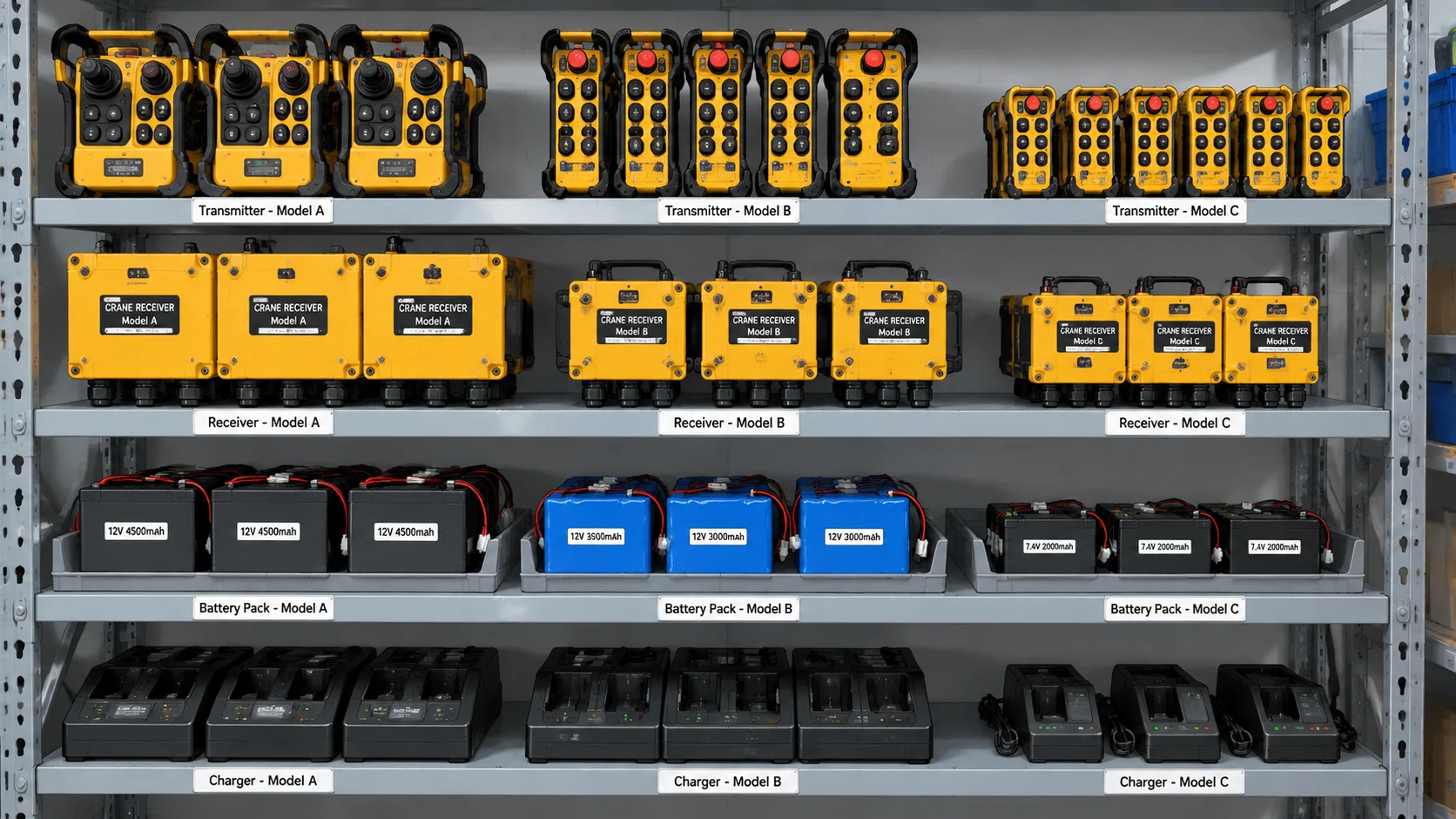
The spare parts bill for a crane remote control fleet is set long before the first failure, at the moment each crane was bought. Six cranes bought over ten years from four suppliers means four battery types, three charger families, two pairing procedures and a store room nobody can audit. Consolidating is cheaper than it looks, but only if the consolidation is written into the contract rather than hoped for.
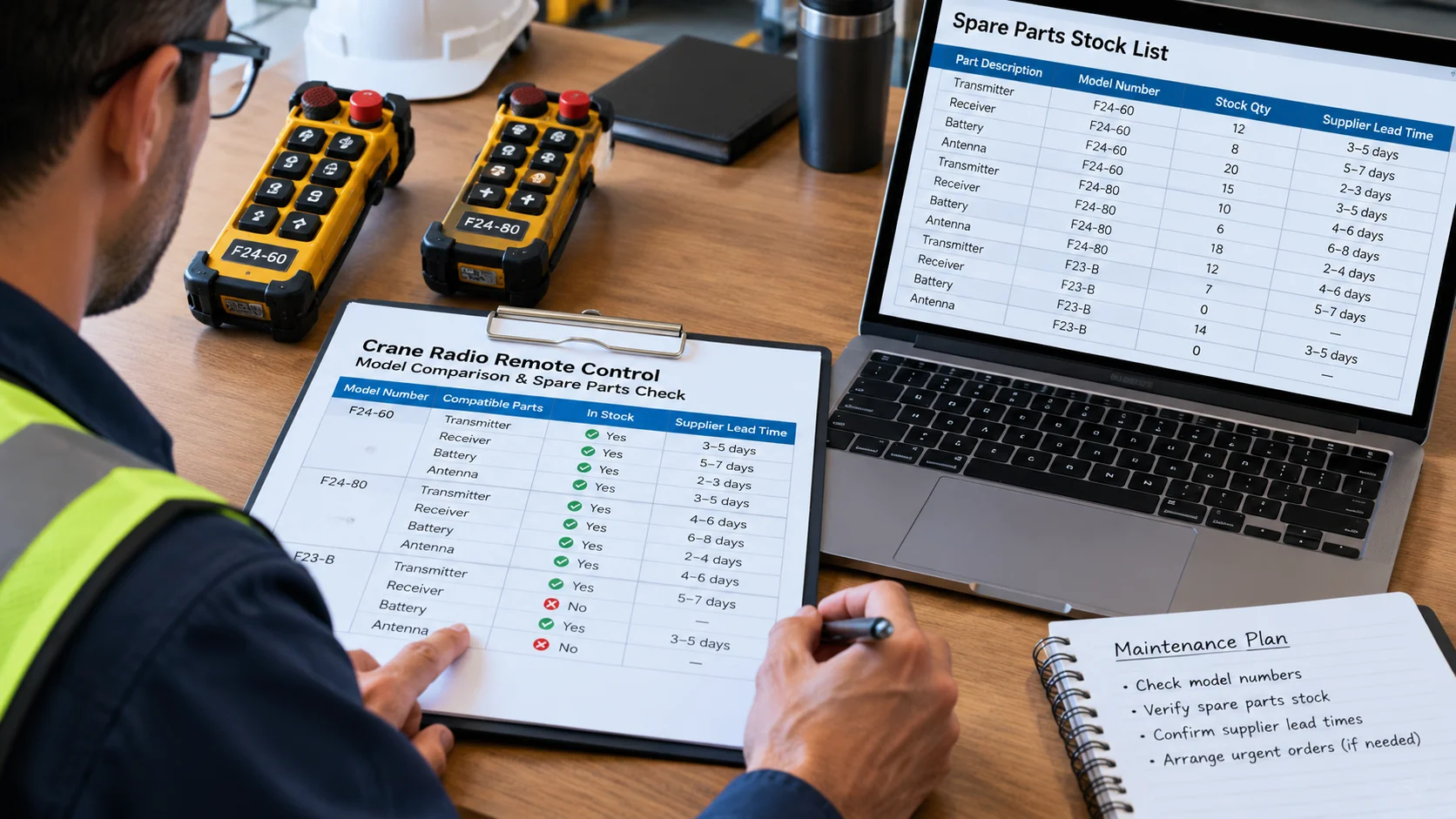
This article is a crane remote control spares strategy for plants running more than a handful of units: how a mixed fleet creates cost, what standardising on one model really buys, how to protect yourself against being locked in, how to size a critical spares holding, and what to write into the supply agreement so that a discontinued model does not turn into an emergency.
The purchase price is the visible cost and the least important one. The costs that accumulate are the invisible kind: a technician spending a shift working out which of four receivers a transmitter pairs with, a store room holding eleven battery variants for six cranes, and a production line waiting for a part that only one distributor stocks.
| Hidden cost | How it shows up | Effect on a ten-crane fleet |
|---|---|---|
| Spares proliferation | Separate battery, charger and relay for each model | More stock value tied up for the same coverage |
| Training spread | Technicians must know several pairing routines | Slower fault finding, more callouts |
| Pairing confusion | Transmitters and receivers that look alike but do not match | Wrong unit sent to site, second trip |
| Documentation drift | No current drawing for some cranes | Longer isolation and commissioning |
| Negotiating position | No volume across any single supplier | List price on everything, weak lead times |
The pattern is consistent: a mixed fleet of ten cranes typically carries more spares value than a standardised fleet of fifteen, because the coverage has to be duplicated per model rather than pooled.
Standardising means the same transmitter family and, where the crane duties allow it, the same receiver family across the fleet. Four benefits follow immediately, and a fifth follows over a couple of years.
The limit is duty. A twelve-function grab crane and a six-function single-speed hoist do not need the same receiver, and forcing one model across both either over-specifies the small cranes or under-specifies the big ones. Standardise by duty class — light, standard, complex — rather than forcing a single part number across the whole plant.
Consolidating to one supplier trades flexibility for simplicity, and the risk is real: price rises at renewal, a model discontinued without notice, or a supply interruption that stops ten cranes instead of one. None of those risks argues against consolidation; they argue for writing the protection into the agreement.
The practical containment is a second, small holding of a different model on the two most critical cranes. That is not a contradiction of the strategy — it is an acknowledgement that the cranes whose failure stops the plant deserve a fallback that does not depend on one supplier’s logistics. For everything else, one source with contractual protection is cheaper.
It is also worth checking that the supplier can actually document what they sell. A CE marking file that can be verified is a reasonable proxy for whether the supplier will still be able to answer a question about a five-year-old unit, and whether the model designation on the carton matches the certificate. Knowing which units are close to that point is the input to the whole calculation, and a 12-point fleet audit is how most sites produce it without guesswork.
Do not stock by intuition. Work from failure rate and lead time, and let the arithmetic set the quantity.
On most fleets that produces a small list. Two spare transmitters, one spare receiver, a battery per transmitter, a set of output relays if the receivers are relay type, and one spare antenna and feeder. Consumables like batteries and relay contacts are the items that actually prevent downtime; the electronics fail far less often than the store room assumes.
Every model is eventually discontinued, and the question is whether you find out from a letter or from a failed crane. Two things make the difference. First, keep the pairing data and the terminal assignment for each installed unit, so a replacement can be chosen and wired without reverse-engineering a panel. Second, agree a compatibility path in advance: which current model replaces the one you bought, whether the receivers are interchangeable, and how long the old model will remain available.
Where a family has a long production history, replacement transmitters for older receivers are often available as compatible units rather than as the original model. That is a legitimate route as long as the addressing and the output count match, and as long as the replacement is described honestly as compatible rather than as original equipment. Buying a complete crane remote control system for the two most critical cranes every few years is often cheaper than chasing obsolete single units.
Five clauses turn a supplier relationship into a supply strategy. They cost nothing at the point of purchase and they are the difference between a planned replacement and a crisis.
The cost comparison behind all of this is more than unit price. A price built from configuration is the only number that can be compared fairly across suppliers, and it is also the number a contract needs, because a spares holding is a percentage of the installed base rather than a guess. If two operators share one crane, the two-transmitter setup also belongs in the fleet plan, since a backup transmitter is a spares decision as much as an operating one.
Usually not on the whole fleet. Replace on failure, and specify the standard model for every new crane and every planned replacement. A fleet converges in three to five years without any scrapping of serviceable equipment.
Two is a common answer, provided both are the standard model and both are kept paired and charged. More transmitters than that tends to mean batteries going flat on the shelf rather than coverage improving.
The same family is usually enough. Compatibility within a family covers batteries, chargers, pairing routines and often receivers, which is where most of the saving comes from. Identical model numbers matter most on the cranes that share a duty class.
A charged battery pack for every transmitter in service, plus one spare pack. Battery failures outnumber electronic failures by a wide margin, and a flat battery looks identical to a dead receiver from the operator’s position.
Rarely for the model itself, but often for a compatible replacement. The clause worth having is a commitment to offer a compatible replacement with the same output count and addressing, together with enough notice to plan the change. Send your fleet list through the contact page and ask for a standardisation and spares proposal against it.