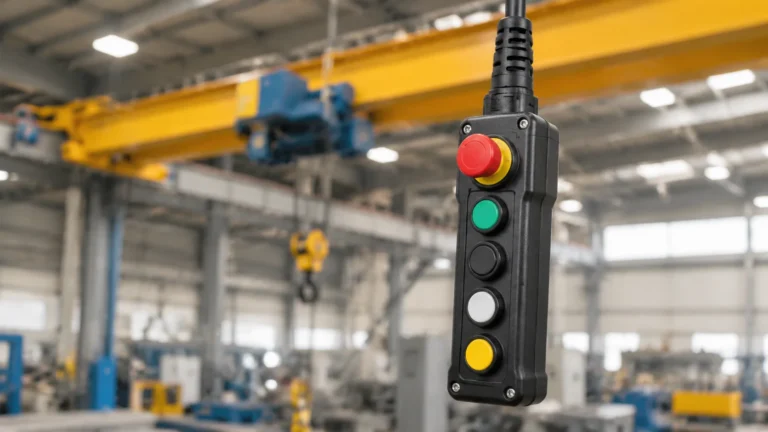
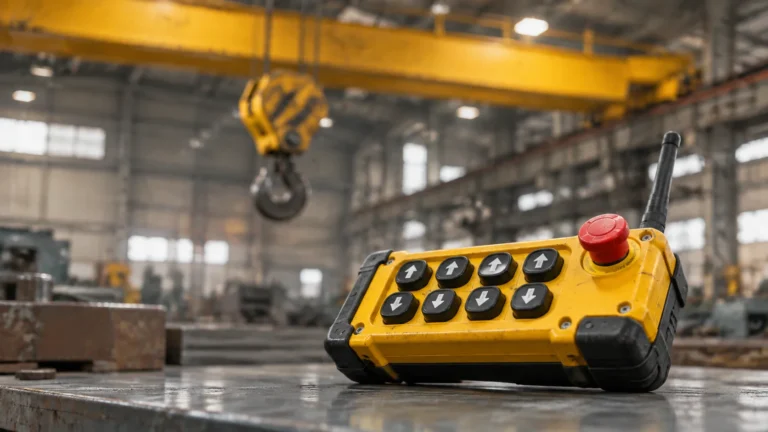
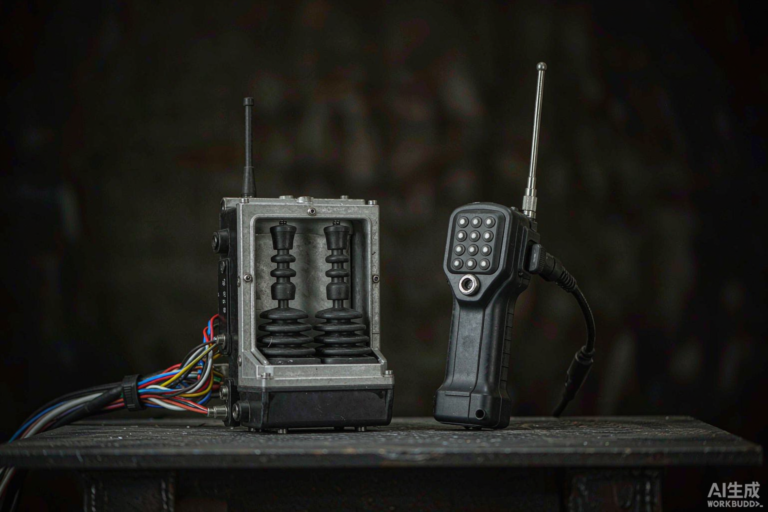
Pendant Control Station Wiring: Cores, Common, Earth
Cores follow functions, not buttons. The sum that sizes the cable, why the stop must not share the button common, and five pre-power checks.
Read More

A foundry crane remote control rarely fails because of radio. In a melting shop the link is usually the healthiest part of the system; what fails is the hardware bolted around it. Heat softens gaskets, radiant load from a ladle bakes the front face of a transmitter, and fine conductive dust finds every joint that is not genuinely sealed.
Two units with the same IP65 rating and the same claimed range can last five years or five months in the same bay. The difference sits in three decisions made at quotation time: enclosure material, receiver position, and whether internal components were rated for the ambient temperature or for the brochure.
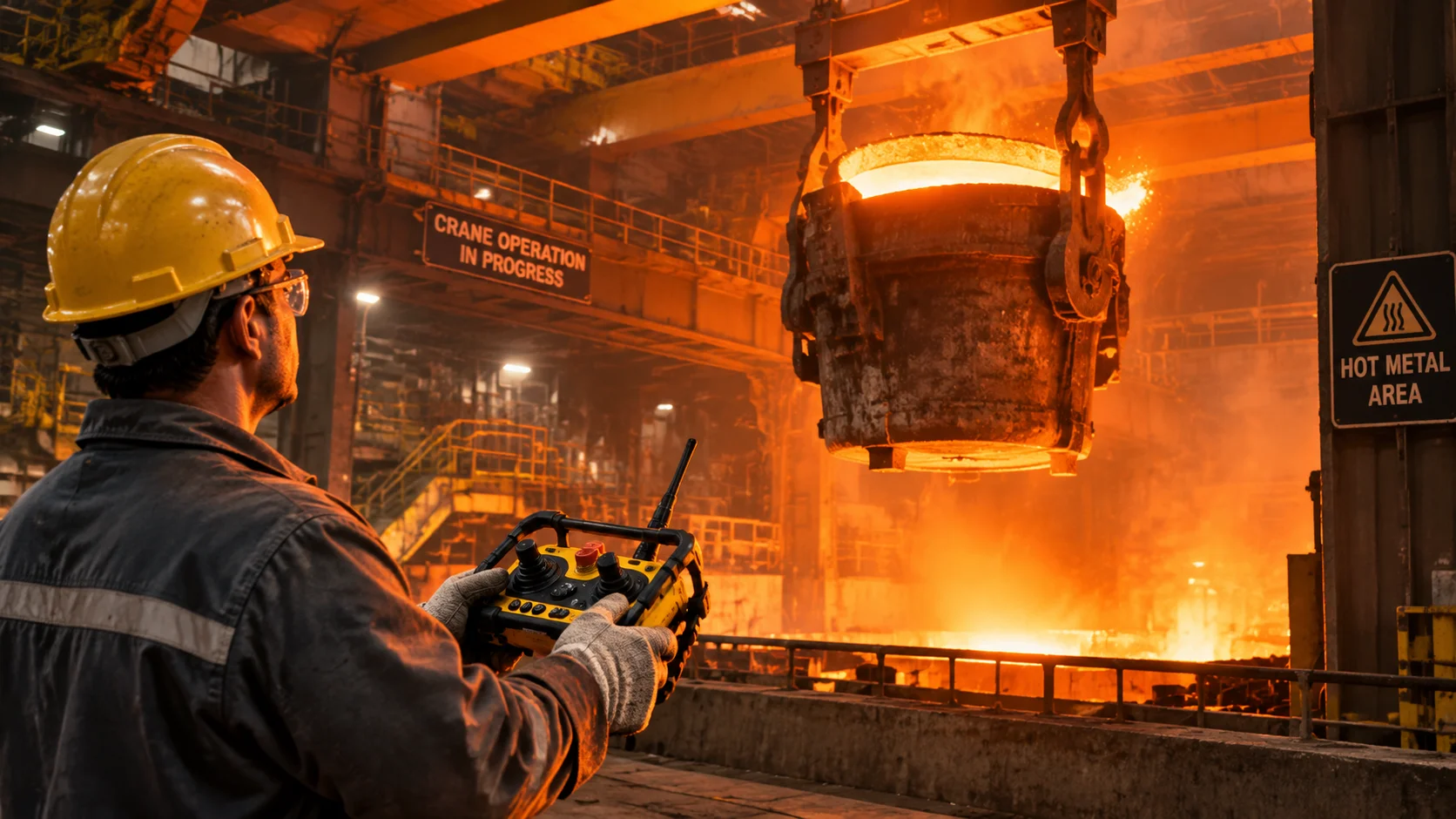
Foundry operators tend to describe the environment as “hot” and buy accordingly. That word hides three stresses with different failure paths and different fixes.
| Stress | What it actually does | Where you notice it first |
|---|---|---|
| Ambient heat | Raises the temperature of every internal part, including relay coils and battery cells | Receiver relays that stick or fail to release after a long shift |
| Radiant load | Heats the surface facing the source while the air around stays cooler | Transmitter front face and display window; buttons that go soft and sticky |
| Conductive dust | Bridges gaps in gaskets and seals, then absorbs moisture | Erratic commands, corrosion on the antenna base, creeping current paths |
Ambient heat is what manufacturers put in a specification; radiant load is what a ladle actually delivers. A transmitter held twelve metres from molten metal receives a concentrated thermal load on one face only, which is why failures cluster on the front of the housing rather than deep inside the electronics.
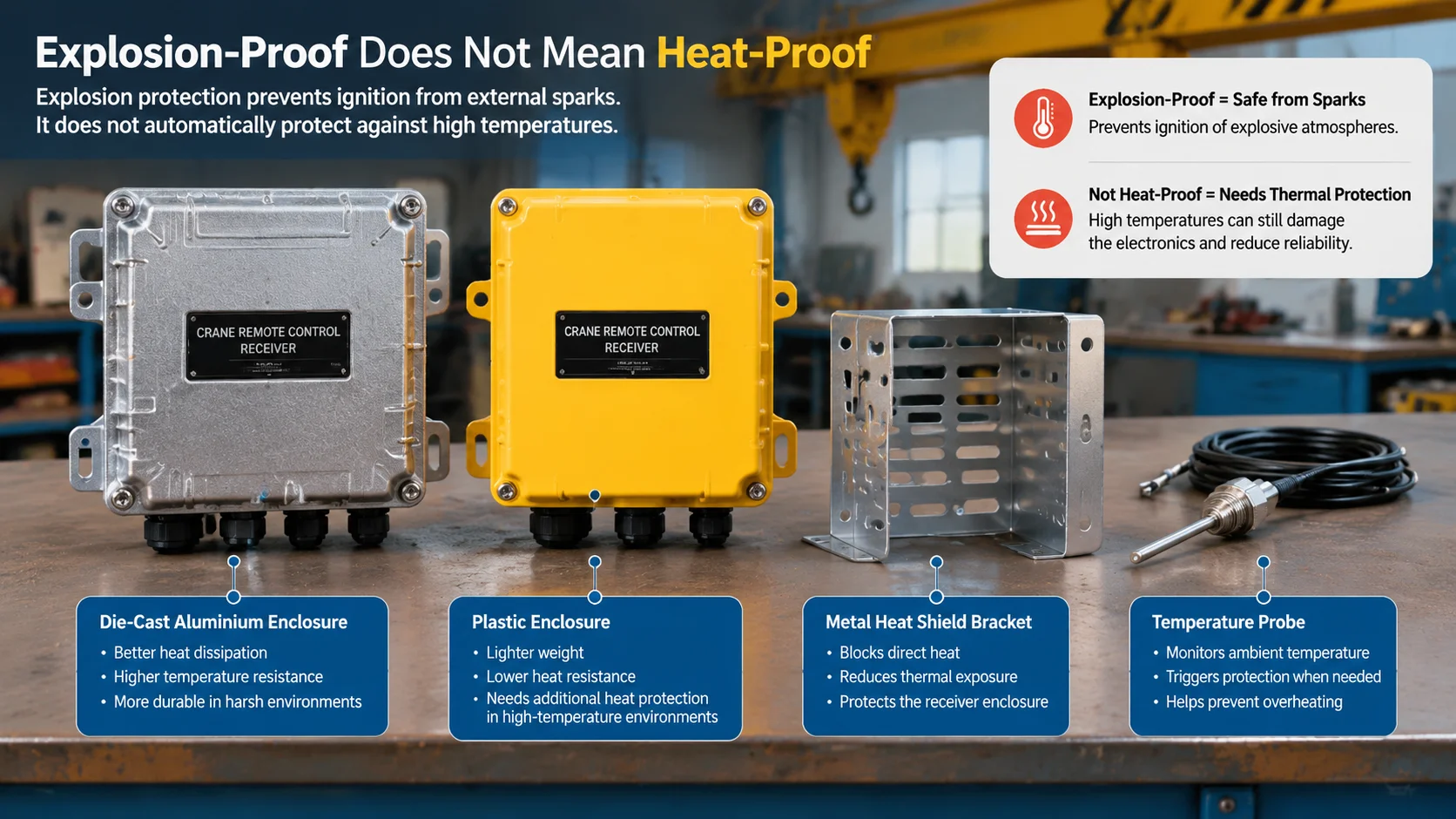
This is the most expensive confusion in the category. Explosion protection addresses ignition risk. It limits surface temperature so that a hot component cannot ignite a surrounding explosive atmosphere, and it contains any internal spark inside a flameproof enclosure. Neither of those objectives makes the internal parts more durable at high temperature.
A surface temperature class of T4 permits a surface up to 135 °C. A silicone keypad bonded with a pressure-sensitive adhesive will not enjoy repeated excursions anywhere near that. A sealed flameproof box is also, by construction, a box that cannot convect heat away, so an Ex-rated unit sitting in a hot bay can run hotter internally than a plain industrial unit of the same size.
In many melting shops the crane itself is not in a classified zone for gas at all. Molten metal handling creates its own hazards, but they are not the ones a gas-group certification is written for. Using an explosion-proof remote control to solve a heat problem is a common and costly mismatch. Ask which specific hazard zone has been classified, and by whom, before that line enters the specification.
A sealed enclosure has no convection, so everything the electronics generate plus everything the housing absorbs has to leave through the walls by conduction and radiation. Wall material is a thermal decision.
| Enclosure | Behaviour in a hot bay | Practical consequence |
|---|---|---|
| ABS or polycarbonate | Low thermal conductivity; absorbs radiant heat and holds it | Internal temperature rises well above ambient; suitable for moderate duty only |
| Die-cast aluminium | Conducts heat through the wall and spreads it across the surface | Hotter to touch, cooler inside; the better choice above roughly 50 °C ambient |
| Plastic plus radiant shield | Shield blocks direct radiation but traps heat behind it | Works only if the shield is spaced off the housing so air can move between |
A metal housing helps only if it is not also insulated by a coat of thick paint or a rubber boot. Where a shield is used, stand it off the housing by 10 mm or more; a shield laid directly against the plastic simply relocates the heat source. A precast yard swaps radiant heat for steam and alkaline dust, which is a different failure path rather than a hotter version of the same one, and precast concrete crane environments follow it through the curing chamber and the outdoor gantry.
Electronics fail last in a foundry. The mechanical stack fails first, and it fails in a predictable order.
None of these appear in a datasheet. The practical test is to ask what the keypad material is, what continuous surface temperature it is rated for, and whether the gasket is a moulded profile or a flat die-cut. A supplier who cannot answer the third question has not thought about dust. Panel mounted controls in the same bay face the same wear, which is why an HNP series joystick switch with a replaceable rubber boot outlasts a bare joystick in a foundry.
Receiver position is free to change and it buys more life than any upgrade. Work through these in order.
These six steps cost nothing at installation and are almost impossible to retrofit later.
Send a temperature with a duration, not a single number. “80 °C” is ambiguous; “65 °C ambient for eight hours, with radiant exposure from a ladle at 4 m” is a specification an engineer can answer.
| RFQ line | Ask for specifically |
|---|---|
| Ambient range | Continuous operating temperature for transmitter and receiver stated separately |
| Limiting item | Which component sets that limit: battery, relay, keypad or display |
| Enclosure | Material, wall thickness, and whether a stand-off heat shield is offered |
| Keypad | Membrane material and its rated continuous surface temperature |
| Sealing | Gasket type and the IP rating with the battery cover opened and closed 50 times |
| Battery | Chemistry, and its capacity derating at the top of the stated range |
| Contact derating | Relay current at your actual internal box temperature, not at 25 °C |
| Documents | Test report for the temperature claim, not only a declaration of conformity |
The F24-12S / F24-12D twelve-button system is the configuration most often specified for melting bay cranes, because twelve outputs cover main hoist, auxiliary hoist and travel with enough spare channels for a magnet or a light. Its datasheet shows how the temperature line is worded, and the IP65 versus IP67 comparison explains why a higher protection number is not automatically the right answer in a dusty bay.
If you are specifying for a melting shop now, send the ambient range and the ladle distance to our engineers and we will tell you which items in your list need to change before the order is placed, rather than after the first gasket fails.
Yes, in many bays. Ambient temperatures in the 40 to 55 °C range with intermittent radiant exposure are handled by aluminium enclosures, sensible receiver placement and a keypad rated for the surface temperature. The failures come above 60 °C continuous or in direct line of sight to the melt.
No. Explosion protection limits ignition risk and contains internal sparks; it does not raise the temperature limits of the battery, keypad or relay. An Ex enclosure can run hotter internally than a plain industrial one because it is tightly sealed. Specify Ex only where a classified zone has actually been defined.
Because contact current rating falls as temperature rises, and because a contactor coil draws several times its holding current for a few tens of milliseconds on pick-up. A relay chosen on its headline 5 A figure at 25 °C is being asked to do more work at 65 °C inside a sealed box.
It is worth fitting as a stand-off shield with an air gap. Fixed directly against the housing it traps heat instead of blocking it. A 10 to 20 mm air gap plus a reflective outer face is the version that works, and it is cheaper than a higher-temperature model.
Check the keypad and gasket visually every shift, and test every button for full return once a week. Replace the gasket at the first sign of a permanent set rather than waiting for water or dust ingress to show up as erratic commands.