Pendant Control Station Wiring: Cores, Common, Earth
Cores follow functions, not buttons. The sum that sizes the cable, why the stop must not share the button common, and five pre-power checks.
Read More

A crane anti sway remote control is often sold as a cure for a swinging load. It is not one. Sway is generated by acceleration and by the time the brake and the drive take to stop the load, and the radio link does not sit inside that loop at all. What a transmitter changes is how finely and how briefly the operator can command a movement, and that is the one sway variable you can actually buy.
Every suspended load is a pendulum, and its behaviour is decided by rope length. At 5 m below the hook the natural period is roughly 4.5 seconds; at 10 m it is closer to 6.3 seconds. Two things excite that pendulum, and neither of them is the antenna.
The first is acceleration of the trolley or the bridge. The faster the drive reaches travel speed, the larger the initial swing angle the operator has to deal with. The second is the second push, which almost always comes from a speed change. A driver gets the load moving, sees that it is travelling too fast, drops to low speed, and the deceleration arrives as a second impulse at exactly the wrong moment. The swing gets worse rather than better, and the driver’s instinct is to correct again.
Set that against the timing of the radio. Receiver latency is a few tens of milliseconds. The delay from de-energising a contactor to a brake actually seating is several hundred. If a load swings, the question to answer is which drive and which brake are doing it, not which handset is fitted.
There are only three levers in the handset. Knowing which one a supplier is talking about saves a lot of confusion.
That is the complete list. A transmitter does not measure sway, does not know the rope length, and cannot correct anything by itself.
Receiver response is usually discussed as a safety topic and rarely as a sway topic, but it matters in one narrow way: consistency. A relay-output receiver releases its contacts after the coil de-energises, and the drive and brake then add their own delays on top. Solid-state outputs release faster and, more usefully, in the same number of milliseconds every time. The real figure to ask about is spread, not speed — an operator learns the timing of a machine and compensates for it by feel, and that learning collapses if the same button gives a different result at 8 am and at 4 pm. Our note on crane remote control response time covers how the delay is measured, and the comparison in relay versus solid-state receiver outputs explains where the variation comes from.
Where a stop point matters — a die, a ladle, a loading dock edge — a maintained output is worse still. The command continues after the hand has left the button, so the load keeps travelling while the operator is already preparing the next correction. If you are ordering a handset for positioning work, the difference between momentary and maintained output behaviour is worth settling before the button layout.

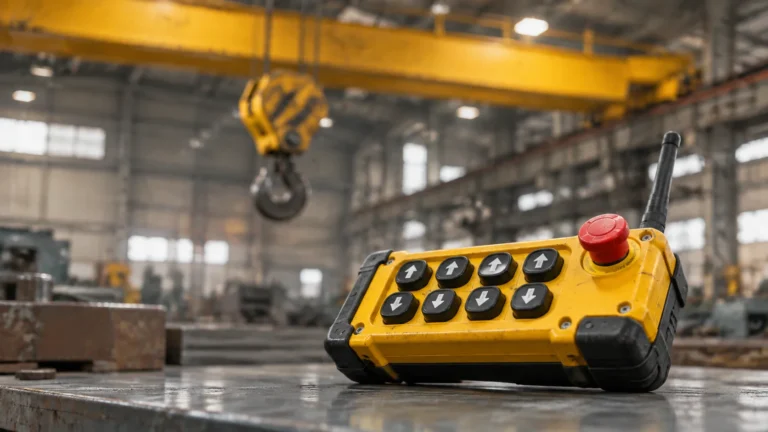
A dual five-step joystick remote control is the usual answer when a buyer asks for smoother control. Five steps per direction give four intermediate speeds between stop and full, which is enough to keep a load creeping at a constant slow rate through a long runway instead of pulsing it forward in bursts. On a 60 m bay that is worth real money in cycle time and in damage to the load.
It is still not anti-sway, for one structural reason: the actuator is the drive, not the handset. If the hoist runs a two-speed motor with direct-on-line contactors, the drive jumps to whatever speed the contactor selects and the joystick step is only choosing which contactor closes. Stepless input and stepless output are two separate purchases. Ask what the travel drive is before choosing the transmitter, and ask what the hoist drive is before believing any claim about smooth lifting.

Whether the machine needs sticks at all is a different question from how smooth the steps are, and joystick or push-button control is where that line gets drawn.
Three methods reduce swing, and they operate at three different levels of the machine. A table separates them faster than any description.
| Method | Where it acts | Effect on swing | Choose it when |
|---|---|---|---|
| Mechanical restraint (guide ropes, rigid mast, anti-sway rope) | Between the load and the structure | Removes most lateral swing by constraint | Fixed bay, short travel, a small number of pick points |
| Electronic anti-sway in the drive | Inside the variable-frequency drive on travel and cross travel | The largest single reduction available, but needs an encoder and skilled commissioning | The load must travel fast and arrive still, and the drives are already VFD |
| Multi-step or proportional handset | At the operator’s hand | Smaller corrections, shorter pulses, less energy added at each stop | An existing machine where the drives cannot be changed |
| Operator technique | Trained behaviour | Large in practice, but it varies by person and by shift | Always, and it costs nothing |
A transmitter upgrade is the only one of the four that needs no work on the crane itself, and it also delivers the smallest change on its own. That is why a supplier who promises that a new handset will stop a 10 m pendulum is either misunderstanding the problem or overselling the product. The honest version is: the handset buys you control resolution, the drive buys you sway suppression, and training buys you the rest.
A supplier can only size the answer if the enquiry contains the physics. Five items are enough for a useful first reply.
With those five answers, a good reply separates what the handset can do from what the drive has to do. If the answer is only a button count and a price, ask again with the rope length in the message. Our industrial crane remote control system page shows the configurations we build most often, and the five answers can go straight into the contact form for a written recommendation. If the machine already has a radio control that behaves unpredictably, the checks in crane remote control not working rule out a link fault before anyone blames the sway.
Only indirectly. It gives the operator finer and shorter commands, which reduces the energy added at each stop. It cannot cancel a swing that is already running, because it has no feedback on load position.
For positioning, usually yes. Five steps per direction allow a smaller correction than a two-speed button. On a two-speed contactor hoist the benefit shrinks, because the drive still jumps between fixed speeds.
It swings more slowly, not more violently. The period grows with the square root of the length, so a 10 m rope takes about 6.3 seconds per cycle against 4.5 seconds at 5 m. A slow pendulum is harder to damp with short pulses and easier to disturb with a second speed change.
Not directly. A few tens of milliseconds is negligible against brake and drive response. Inconsistent latency is the real problem, because the operator cannot learn a timing that keeps changing.
It normally refers to electronic sway control inside the variable-frequency drive, not to a feature of the handset. Confirm which unit the function lives in before assuming a new remote control will provide it.