Pendant Control Station Wiring: Cores, Common, Earth
Cores follow functions, not buttons. The sum that sizes the cable, why the stop must not share the button common, and five pre-power checks.
Read More

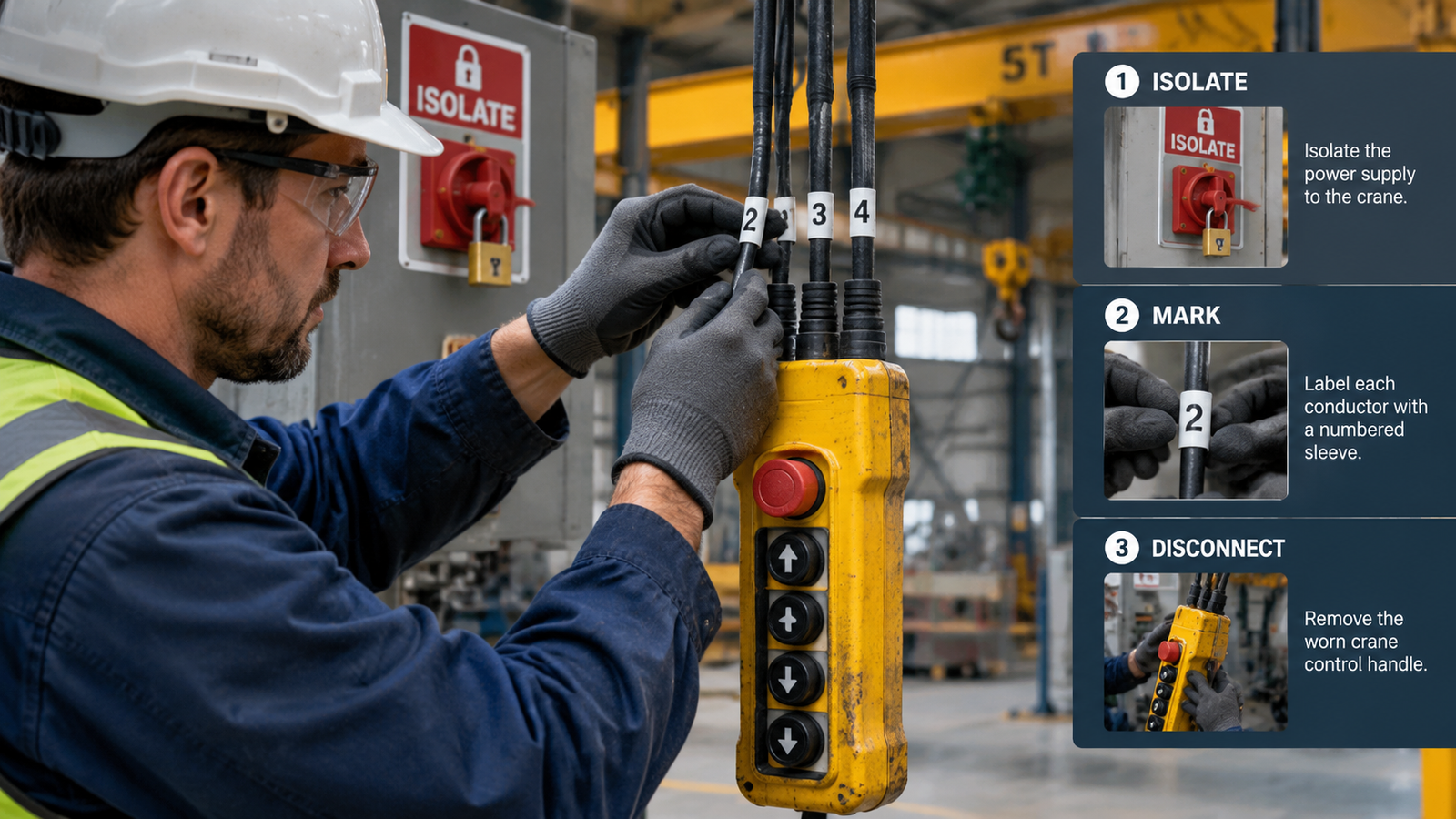
Replacing a worn control handle on a crane is usually a two-hour job that goes wrong for one of three reasons: the circuit was not marked before disconnection, the replacement has the wrong contact arrangement, or the old station was the only thing holding the cable gland tight.
This guide covers what tells you a handle is finished rather than repairable, the isolation and marking sequence that makes the swap reversible, and how to match an XAC model to the machine so the new station is a drop-in fit instead of a rewiring project.
Wear is cumulative, and most of it is visible long before it becomes a fault. Where the whole station rather than the handle head is being replaced, the COB-6 pendant control switch is the comparable format in 2, 4, 6 or 8 buttons, and the button count usually decides the length of the body.
| What you see | What it usually means | Repair or replace |
|---|---|---|
| One function works only when the button is pressed at an angle | Worn contact block or a cracked actuator plunger | Repair — replace the contact element |
| Button feels spongy and does not spring back cleanly | Perished diaphragm or a fatigued return spring | Repair if the housing is sound; replace if the diaphragm seat is damaged |
| Functions work intermittently in wet weather | Water tracking in at the cable entry, or a hardened gasket | Replace — the enclosure has lost its seal |
| Cable stiff, cracked sheath, exposed conductors at the boot | Cable fatigue from repeated flexing at the strain relief | Replace the cable; replace the station if the boot is moulded into the housing |
| Legends worn through, buttons unreadable | Abrasion over years of glove contact | Replace — unidentified controls are a safety defect |
| Emergency stop does not latch or does not release cleanly | Damaged latching mechanism in the head | Replace immediately and take the machine out of service until it is done |
| Housing cracked at a mounting tab or screw boss | Impact or over-tightened fixings | Replace — a cracked enclosure cannot be resealed |
On a cable-connected handle, most intermittent faults are not in the button at all. They are at the terminal screws, where a conductor that was tightened once has relaxed under thermal cycling, or at the contact element, where silver has oxidised after moisture found its way past a gasket.
On the XAC pendant family the enclosure is double-insulated polypropylene rated IP65, built to IEC 60947-5-1, with a thermal current rating of 10 A that allows the buttons to switch modest loads directly. That 10 A figure is worth reading carefully during a replacement: if the old station was switching a contactor coil, the new one will be comfortable; if someone has wired it to a small motor or a solenoid at the edge of the rating, the contacts will be the next thing to fail. Check what the circuit actually draws before fitting the same model again. Where the machine runs two speeds, the replacement has to be a two stage station rather than a single speed one, and the COP-3MD double speed pendant is the model to match the terminal count against.
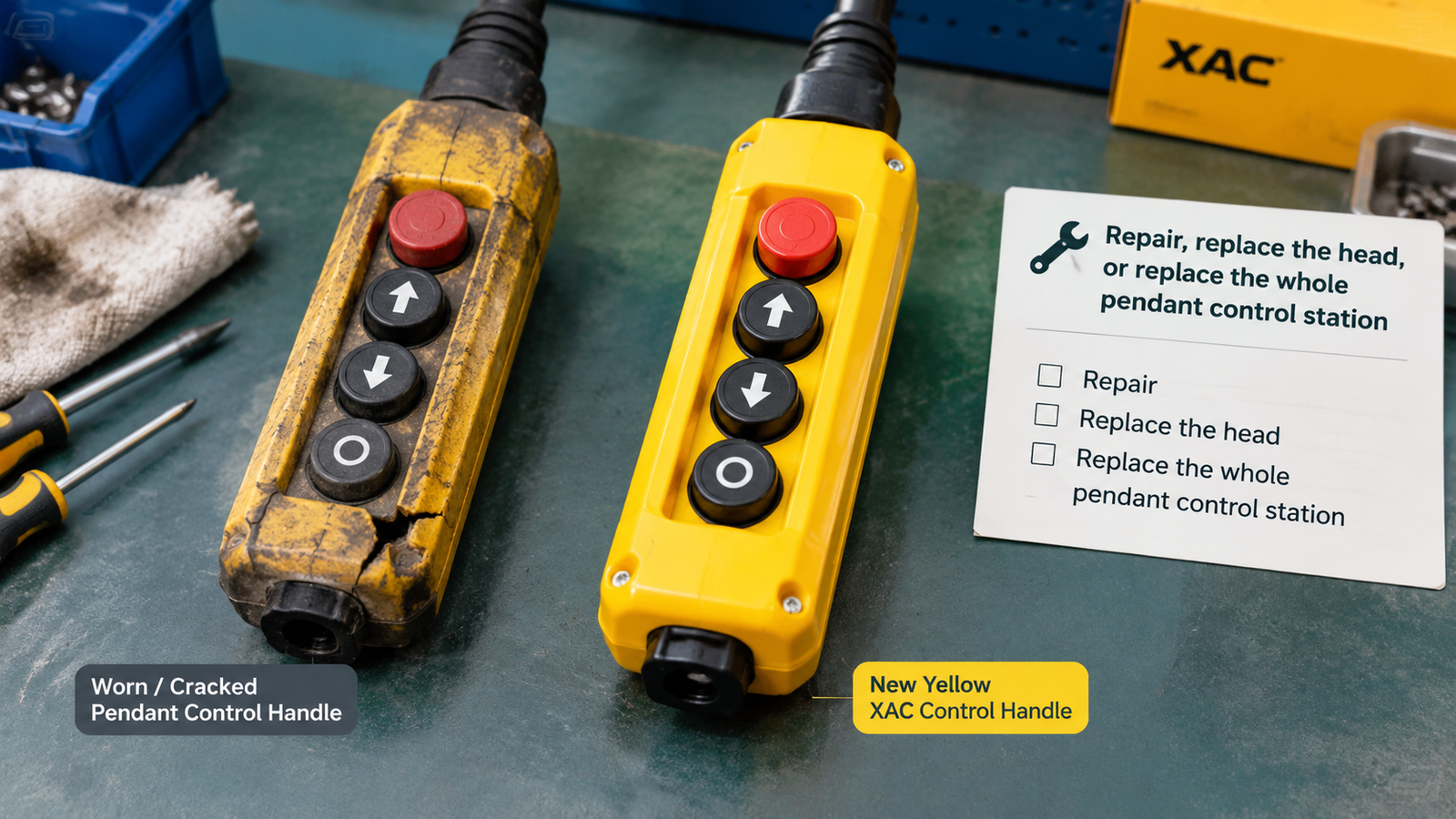
| Option | When it is right | What it costs you |
|---|---|---|
| Replace a contact element or button | Single function faulty, housing and gasket sound, replacement part available | Lowest cost, but the station is already off the machine — the labour is the same as a swap |
| Replace the cable only | Enclosure sound, cable failed at the boot, correct cable available | Cheap and quick, provided the entry can be resealed to the original standard |
| Replace the station with the same model | Enclosure, cable and contacts all showing age; model still available | Straight swap, same wiring, same mounting, no drawing changes |
| Replace with a different configuration | Function count no longer matches the machine, or the station is being upgraded at the same time | Wiring changes and a drawing update — plan it, do not discover it on the day |
The XAC control handle range covers the common crane and hoist duties in three steps. The XAC-A271 two-button handle covers a single motion in two directions, or serves as a local jog point on larger equipment. The XAC-A2713 adds a mushroom-head emergency stop at the head of the button column and keeps the two-button layout, which is the usual replacement for a hoist handle where the original had a stop. The XAC-A6713 takes the same sealed housing up to six buttons plus the stop, for machines with up to three paired motions driven from one control point.
Two selection points are easy to get wrong. The first is cable entry direction — a station built for a cable leaving the top will not fit a machine where the cable has to leave the bottom, and forcing it puts a permanent bend at the boot. The second is whether the site requires a cable-connected station at all. Where the risk assessment does not accept wireless control, or where the operator works from a fixed position, the wired handle is the correct choice; where the machine is also being fitted with radio, the handle usually stays as a local control point.
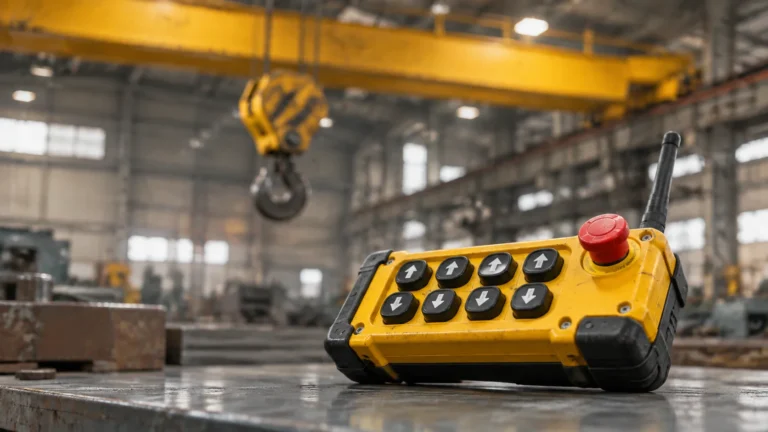
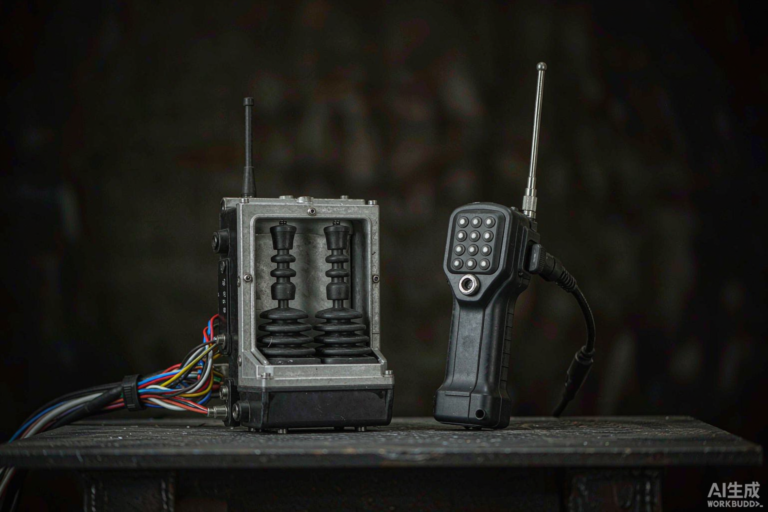
That second case is worth planning rather than discovering. Sites that add radio control to an existing crane normally keep the pendant, because the pendant is the fallback when a transmitter is dropped or a battery is flat. The industrial remote control range lists the receiver and transmitter options that can be installed alongside an existing handle circuit, with the receiver wired in parallel to the pendant contactors so both control points remain live.
Test every function one at a time with the machine empty, in both directions, at creep speed where the drive allows it. Test the emergency stop under load — not just at rest — and confirm that the drive stops and stays stopped until the actuator is reset. Then test the same functions from any second control point on the machine, because a parallel-wired receiver can hold a function the pendant does not.
A crane control handle replacement is worth doing when the enclosure has failed, not when a single button has. Mark the conductors before disconnecting, match the contact arrangement rather than the button count, and test the stop under load before the crane goes back to work. The XAC pendant control series covers the standard replacement sizes, and if the machine is due to move to radio control at the same time, the two can be planned as one job.
Send the drawing, the contact arrangement and the cable entry direction through the contact form and the correct model can be confirmed before you order — the most expensive part of a handle replacement is a second one.
It depends almost entirely on duty cycle and environment. A handle in a clean indoor workshop on light duty can run for many years with contact element replacement; the same handle on an outdoor crane in daily use with a cable flexing at the boot will need the cable or the station itself much sooner.
Yes, when the housing, gasket and cable are sound and the replacement element is available. In practice the station is already off the machine at that point, so the labour saved is small — which is why replacement of the whole station is often the better value once the enclosure shows age.
The contact arrangement is different. The same button count can be supplied with normally open or normally closed contacts in different combinations, and the panel expects one specific arrangement. Always compare the contact type and count against the drawing, not the front of the station.
Yes. A receiver wired in parallel with the pendant contactors can hold a function energised even when the pendant circuit is dead. Isolate the receiver supply as well and prove dead at the pendant terminals before disconnecting anything.
Yes, and it is a common arrangement. The receiver is wired in parallel with the pendant contactors so either control point can operate the machine. The two must share a single emergency stop circuit, and both should be tested at commissioning so that neither can defeat the stop.